Real estate · industry report
How Real Estate Agents Use AI: Real Cases by Task
As of October 2026, our 27 cases show real estate agents using AI first for marketing text: listing descriptions and social posts. Newer cases go further and connect Claude to the CRM, the MLS, a browser or Canva to do routine work. Few cases give a result number, and every number is self-reported. Many of the deepest setups come from people who sell AI training or kits.
- Marketing text comes first: listing descriptions are the most common task, and social posts are the second writing task.
- Use shifts from ChatGPT writing one text (2023–24) to Claude connected to the CRM, MLS, browser or Canva (2025–26).
- Few cases give a result number, every number is self-reported, and some numbers show failure.
- Most agents who talk about errors say a person must check the output, but many short clips show no check at all.
- Many of the most built-out setups come from people who sell AI training, kits or setup help.
Contents
What do real estate agents use AI for?
Agents mostly use AI for work they already do by hand, one task at a time. We have 27 records across 6 task groups. Not counting the 1 record that only warns, they come from 20 people. The chart shows how they split.
Records per task
Listing descriptions
This is the most familiar use. The workflow has three steps (Brad Cohen; Broker-owner, The List Realty):
- Collect the facts. The agent pastes notes from the listing appointment and the MLS sheet.
- Get a draft. The AI writes a first version.
- Edit it. The agent edits or rewrites the draft in their own voice.
The finding: AI removes the blank page, but these agents still edit or rewrite the draft. One agent argues against the whole practice (@sandyisyouragent). See listing descriptions.
Social media and local content
This is the second writing task. In most of these cases the input is the agent’s own local data or templates, not a general question:
- MLS sales data. One agent exports six months of MLS sales for one subdivision and turns them into posts for that neighbourhood’s Facebook groups (@sandyisyouragent).
- Canva templates. Another has Claude fill Canva templates with her photos and captions (Carrie Dahle, 2 cases).
The finding: local data and the agent’s own templates make the output specific. See social media and local content.
Lead follow-up and CRM
These cases connect an AI assistant to Follow Up Boss. The assistant sorts leads, adds new contacts from a screenshot or a voice note, and drafts follow-up texts (Aidan Holt, 2 cases; William Zhang, 2 cases).
The finding: the AI makes the list, but the agent still makes the calls. All of these records come from 2 people, and both sell AI training. See lead follow-up and CRM.
Transaction management
These cases use AI after a contract is signed:
- One prompt, three outputs. A checklist, a client email and calendar dates (@itsabbieweldon).
- A drafted offer (@donnagonzalezdestin).
- Bots that file deal email and prepare addendums (Mike Weisman).
The finding: this is the least proven work here, because no record shows the output being checked. See transaction management.
AI CMA and comps: what three agents do
Three agents use AI to collect comps for a CMA. The AI collects, and the agent still judges:
- Comps in Chrome. Claude clicks through web pages to collect comps. The agent reviews every comp before he uses it (@eduardodurantx).
- His own rules. An agent has Claude write a CMA for each seller lead with his own rule for comps. He says the result is close to what he gets by hand (Jonathan Dickey).
- A sold kit. A team lead’s CMA skill reads the MLS or a CSV. She can swap comps she does not like, and she says the agent still sets the price. She sells the kit (@coritessier, 2 cases).
See AI CMA and comps.
Smaller groups
These groups do not yet have at least two people and three cases for their own page:
- AI cold calling, a form of AI for real estate prospecting (@justbigrealty). One more agent has an AI voice assistant call his new ad leads (Jonathan Dickey).
- One record each for an agent bio (@maddiebennett.realtor), an AI testimonial video (Terry Carn) and team business plans (Emily Barry).
All of them are in the case register.
How the way agents use AI is changing
The tools changed, and so did the job the agent gives them. In 2023–24 an agent asked ChatGPT for one piece of text and used the answer. In 2025–26 more agents connect Claude to the tools they already use and let it do routine steps.
3 records are from 2023–24 and 24 are from 2025–26. 9 records name ChatGPT; 13 name Claude.
Tool by period: 2023–24 vs 2025–26 (all real-estate records)
The earlier records follow one simple pattern: ask for text, use the answer.
- 2023, listing copy. An agent copies a Zillow page into ChatGPT, asks for an MLS description, and clicks “regenerate” if the first draft is too basic (@kalachejackson_realtor).
- A bio. Another asks ChatGPT for a bio and saves it in a Google Doc (@maddiebennett.realtor).
- 2024, a video script. An agent asks ChatGPT to compare two neighbourhoods by name and turns the answer into a TikTok script (@kristamashore_).
In these records no notes or MLS export go in, and no other tool is connected.
The current records connect the AI to other tools:
- The CRM. A Claude assistant reads Follow Up Boss each morning and says which leads to call (William Zhang, 2 cases).
- The MLS and the web. Claude in Chrome clicks through web pages to collect comps (@eduardodurantx), or reads the MLS for a CMA report (@coritessier, 2 cases). Another agent has Claude search a county website for leads’ home addresses (Jonathan Dickey).
- Design tools. Claude fills Canva templates and runs a monthly newsletter as a scheduled task (Carrie Dahle, 2 cases).
- Email and calendar. One prompt adds key contract dates to Google Calendar (@itsabbieweldon), and a set of bots sorts transaction email into the right deal (Mike Weisman).
ChatGPT has not gone away. A current agent uses a custom GPT to make seven pieces of listing marketing from one input (Brad Cohen), and another uploads an MLS export to paid ChatGPT (@sandyisyouragent). For every ChatGPT case, see how to use ChatGPT for realtors. The shift is less about the brand and more about the step: from “write this paragraph” to “do this job inside my tools”.
What results agents report
Most records give no number, and some say only that AI saves “so much time” (Carrie Dahle; @coritessier). 8 of 27 records state a number. Every number below is self-reported, and we did not check any of them.
Reported results (all real-estate records, self-reported)
- Brad Cohen: ~30 min → ~2 min per description; 7 listing deliverables in minutes
- @kalachejackson_realtor: Draft in under 30 seconds
- @savvy.realestate: Hours → ~20 min; "2–3× more productive" (tasks not named)
- Aidan Holt (log an incoming call…): 15–20 s of dictation instead of ~5–10 min of typing per contact
- @justbigrealty: "point zero zero eight cents" a call (unit unclear); not 20 hours cold calling
- Aidan Holt (clean up the CRM…): CRM cut from ~1,200 contacts to 402 real people
- Jonathan Dickey: 11 AI calls, 0 appointments; 19 leads at $7.12 each
- @kristamashore_: About 3 minutes for comparison + script
The time savings are about small, repeated steps:
- Listing descriptions. About 30 minutes down to about 2 minutes per description, after edits (Brad Cohen).
- CRM contacts. 15–20 seconds of dictation instead of about 5–10 minutes of typing each new contact, from an agent who sells a paid AI community (Aidan Holt).
- Neighbourhood script. A comparison of two neighbourhoods plus a one-minute script in about three minutes, from an agent who promotes her own AI event (@kristamashore_).
- Unnamed tasks. “Tasks that used to take hours take 20 minutes”, from a caption that does not name the tasks or the tool (@savvy.realestate).
One number is about cleanup, not time: a CRM cut from about 1,200 contacts to 402 “real” people, from the same seller of a paid community (Aidan Holt). No deal or time saving is reported for it.
Some numbers show failure, and we keep them:
- AI voice calls to new leads. In a public experiment, an AI voice assistant made 11 calls and set 0 appointments. Leads hung up or said “not today”, and one call went to a lead the agent had already spoken to (Jonathan Dickey).
- AI cold calling. An agent who uses an AI voice agent says he no longer spends 20 hours on cold calling. He also says people mark his number as spam, and his cost per call is unclear (he does not say if it is cents or dollars) (@justbigrealty).
No record reports more closed deals as a number. One agent, who sells AI training, says a lead his assistant flagged became a closed deal, but he gives no count (William Zhang).
Where AI goes wrong for agents
Most agents who talk about errors make one point: a person must check what the AI makes. The problems they name are specific:
- Not your voice. Drafts come out generic or “not exactly my voice”, so agents edit or rewrite every draft (Brad Cohen; Broker-owner, The List Realty; @sandyisyouragent; @kristamashore_).
- Made-up facts. One broker-owner says the AI “does make things up sometimes” (Broker-owner, The List Realty).
- A wrong comp costs money. An agent who lets Claude collect comps reviews every one himself. He says a wrong comp could cost him over $10,000 in commission (@eduardodurantx). The agent who sells a CMA kit says the AI collects the data, and the agent still sets the price (@coritessier, 2 cases).
- MLS rules. The same agent tells others to check their MLS rules before they let a browser extension read it (@coritessier).
- Time and stress. One agent says building AI tools distracted him from important work for two weeks (Aidan Holt). Another says a daily report of everything he did not do “really burned me out” (William Zhang).
We keep the records that argue against a practice (1) or only warn about it (1):
- Against AI listing copy. Flowery openers push the HVAC, the windows and the lot size below the few lines Zillow shows on a phone (@sandyisyouragent).
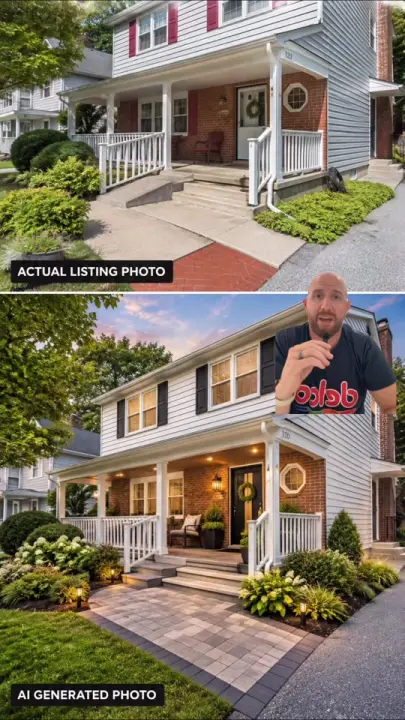
- Caution on AI photos. AI “improved” photos can drift far from the real house (@chriswhartonrealtor).

Argues againstTikTok2025-04-04
@sandyisyouragent — listing descriptions
The agent asks others to stop using ChatGPT for "flowery, adjective-written" listing descriptions.
ChatGPT (argues against) · Negative view, no number
CautionTikTok2026-10-14
@chriswhartonrealtor — listing descriptions
The agent took real photos of the kitchen and backyard from one of his own recent listings and asked ChatGPT to "improve" them, then to go further.
ChatGPT (images) · No number; a warning
There is a gap between what agents say and what they show. Many records do not show a check at all:
- 2023, listing copy. One agent sends the draft straight to the MLS with no edit shown (@kalachejackson_realtor).
- Current clips, no review on screen. A newsletter that runs on a schedule (Carrie Dahle), a CMA texted from a phone (@coritessier), and a contract checklist and a drafted offer (@itsabbieweldon; @donnagonzalezdestin).
- A testimonial video. It was made with AI from a client’s photo and review, after she said no to video. The agent does not say if she approved it or if it is labelled as AI (Terry Carn).
Who is telling these stories
13 of 27 records have a business tie. Most often the person sells a course, a kit, a paid community or a setup service. Other ties are a free download for contact details, a promoted service or event, a group the agent works with, or a host who sells the tool.
Conflict of interest, 27 records (all real-estate records)
The flags cluster in the deepest setups:
- Lead follow-up. Both people in these records sell AI training or a paid community (Aidan Holt, 2 cases; William Zhang, 2 cases).
- CMA reports. The report skills are sold as a kit (@coritessier, 3 cases).
- Transaction bots. The multi-bot setup comes from a team leader who runs AI training (Mike Weisman).
- Business planning. The GPT comes from the coach who hosts the interview and sells the programme (Emily Barry).
This matters for two reasons:
- A reason to look good. A person who sells setup help has a reason to make the setup look easy and the results look large.
- They choose what to show. Both records that only warn come from agents with no business tie (@sandyisyouragent; @chriswhartonrealtor).
A flag does not make a case false. The sellers often show the most detail, and some name their own problems (William Zhang; @coritessier). Read their cases as a clear picture of what is possible, not as proof of what it pays.
For a plainer view, look at agents with no business tie, for example the custom GPT for listings (Brad Cohen), the Canva posts (Carrie Dahle) and the comps from Chrome (@eduardodurantx).
How to use AI in your real estate business: where to start
The cases support a few modest steps. They do not show which tool is best, and they do not prove that AI brings more deals.
- Start with a writing task you already check. Listing descriptions and local posts are the most common writing tasks in our records. The input is facts you already have, and you already read the output before it goes out (Brad Cohen; @sandyisyouragent).
- Give it your own facts. Several cases paste in notes from the listing appointment, the MLS sheet or an MLS export, not a general question (Brad Cohen; Broker-owner, The List Realty; @sandyisyouragent).
- Edit every draft and check every number. Agents rewrite drafts in their own voice and review comps before they use them (Broker-owner, The List Realty; @eduardodurantx).
- Treat the deeper workflows as optional, and know who shows them. CRM assistants, CMA kits and transaction bots mostly come from people who sell setup help (William Zhang; @coritessier; Mike Weisman). A few agents with no business tie do connected work on a smaller scale: Canva posts and a newsletter (Carrie Dahle, 2 cases), comps in Chrome (@eduardodurantx) and a contract checklist (@itsabbieweldon). The builders also report a cost in setup time (Aidan Holt, 2 cases).
- Be careful with anything that speaks or shows a picture for you. AI calls set no appointments in one experiment (Jonathan Dickey), cold-call numbers get marked as spam (@justbigrealty), and AI photos can show a home that does not exist (@chriswhartonrealtor).

Shares numbersYouTube2025-09-03
Brad Cohen — listing descriptions
Brad used to sit down with his notes from the listing appointment and the MLS sheet and spend about half an hour on each description.
ChatGPT → custom GPT · ~30 min → ~2 min per description; 7 listing deliverables in minutes · self-reported
Limits of this report
This is a small set of public, first-person cases. It is not a survey, and it does not show how many agents use AI.
Who shares a result number, 27 records (all real-estate records)
- Small sample. Some people appear in more than one record. Lead follow-up rests on 2 people, and each smaller group has only a few sources.
- Self-reported. Every result is the person’s own claim. We did not check any number.
- Selection. We find cases through public videos and posts. People who post about AI are more likely to like it, and many have something to sell.
- Short clips. Many records come from short videos or captions. They often skip the steps, the output or the review.
- Snapshot. Tools change fast. The setups in this report may already look different.
How we find, sort and flag cases: How we collect cases. Every record: case register.
Questions agents ask
How do real estate agents use AI?
Mostly for work they already do by hand. In our 27 records the most common job is listing descriptions, then CMAs and comps. Social posts, lead follow-up and transaction work come next (Brad Cohen; @sandyisyouragent; William Zhang; @itsabbieweldon; @eduardodurantx).
Realtors using AI: what’s actually working for you?
Most agents who share numbers name small steps. One says a listing description went from about 30 minutes to about 2 (Brad Cohen). Another cut his CRM from about 1,200 contacts to 402 real people, and he sells a paid community (Aidan Holt). Not every number is good news: one AI calling test set no appointments in its first week (Jonathan Dickey). Every number is self-reported.
Is anyone actually using AI in real estate yet, or is it all just hype?
20 different people describe their own use of AI in these records. But not every agent is a fan. One argues against AI listing copy (@sandyisyouragent), and one warns about AI photos (@chriswhartonrealtor).
How can I use AI in my real estate business?
Start simple, and edit what you get. The simplest records paste listing facts into ChatGPT for a draft or ask it for a bio, but they show no editing step (@kalachejackson_realtor; @maddiebennett.realtor). The current agents who write listings with it edit every draft (Brad Cohen; Broker-owner, The List Realty). The setups that connect AI to the CRM or a team’s email both come from people who sell AI training (William Zhang; Mike Weisman).
Can AI do a CMA for a real estate agent?
It can collect the comps, and most of these agents say they still check them. One agent reviews every comp Claude finds (@eduardodurantx). Another says his AI CMA is close to his own (Jonathan Dickey). A kit seller says the agent still sets the price (@coritessier, 2 cases), but her phone caption mentions no check before the report reaches the client (@coritessier). More in AI CMA and comps.
9. Read by task
By tool: Claude for real estate agents · ChatGPT for realtors.
10. Every record
All 27 records, with filters by task, tool and "shares numbers", are in the case register. How they are chosen, ordered and labelled: How we collect cases.